
What Everyone Gets Wrong About Shavuot
Every Jewish holiday has its own clear, defining mitzvah or physical symbol, except for Shavuot. Why is that? Moe Mernick shares a profound insight…
Read more
Every Jewish holiday has its own clear, defining mitzvah or physical symbol, except for Shavuot. Why is that? Moe Mernick shares a profound insight…
Read more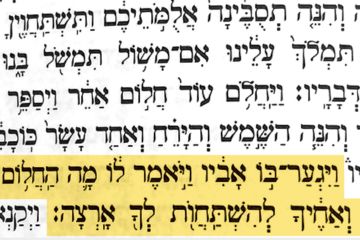
“His father scolded him (Joseph) and said: What is this dream that you have dreamt! Your mother and I will bow down to you?!” A fascinating message is hidden within the letters of this verse…
Read more
In the Torah portion of Vayigash, Joseph reveals himself to his brothers. Before the brothers leave Egypt, Joseph gives them a gift to take back to his father Jacob. It was an aged bottle of wine. The question is asked: Why an aged bottle of wine – what is so important about this bottle of wine? Did his father need wine at this time? Rabbi Ari Enkin shares the important lesson that we learn from this bottle of wine.
Read more
Rabbi Enkin is often asked by women if the Torah permits an ultrasound to reveal the gender of a baby before it’s born. Perhaps the answer can be found in the Torah Portion of Toldot when Rebecca and Isaac have twins, Jacob and Esau. Rabbi Ari Enkin Shares the insight.
Read more
Throughout the Torah there are many conversations recorded. Between Abraham and Sarah, Abraham and the angles who came to visit him, Abraham and the Kings – but yet there is only 1 short conversation between Abraham and his beloved son Isaac. A total of only 15 words. How is it that Isaac became who he was with very little fatherly input and fatherly teachings? What was the parenting and leadership secret that was known to Abraham?
Read more
Abraham received 10 tests of faith. The first 9 tests were commanded to Abraham, where as the final 10th test, of Sacrificing Isaac on the Alter, was asked of Abraham. The question is asked, why was the final test different and what we can learn from it. Rabbi Ari Enkin shares the insight.
Read more
In the Torah portion of Lech Lecha we are introduced to Abraham – He was the first Jew. He taught the world about G-d. He did acts of kindness to no end. He was told by G-d that it was time to move to the land of Israel and when he arrives, the verse states “He pitched his tent” – but the words “his tent” are spelled strangely in the verse. It’s spelled with a letter hei and not a vav. Implying something else. Rabbi Ari Enkin shares an important lesson in life, and reveals yet another point of greatness found in Abraham our forefather.
Read more
As Noah is preparing to finally leave the ark he sends out a Dove to find dry land – The Dove returns with an olive leaf / branch in its beak. The wording that the verse uses is ‘taraf befi’hah” which is an oddly aggressive word for the circumstances. From this we learn an important lesson…
Read more
In the beginning of Creation – after every creation the Torah says “it was good”. However, after the creation of Adam and Eve it does not say “it was good”. We know that man was created in G-d’s image. The pinnacle of creation. So why does the Torah not say “it was good” – Rabbi Ari Enkin shares an insight.
Read more
In the Torah Portion of Ki Tavo we learn about the offering of the first fruits. The farmer would bring his first fruits as an offering to G-d. The rich man and poor man alike would bring the fruits in a basket or platter. Yet, the poor man’s basket was taken by the priest and not returned , while the rich man’s platter was returned. Why does the poor man have to lose his basket as part of the offering while the rich man gets to keep his? What is G-d telling us by this? Rabbi Ari Enkin shares an insight…
Read more